
Key Factors for Selecting a Desulfurization Limestone Grinding Mill
We provide a wide range of mills — including Raymond mill, trapezoidal mill, vertical mill, ultrafine mill, and ball mill, obtained ISO9001 international quality certification, EU CE certification, and Customs Union CU-TR certification. Suitable for processing minerals such as limestone, phosphate, quicklime, kaolin, talc, barite, bentonite, calcium carbonate, dolomite, coal, gypsum, clay, carbon black, slag, cement raw materials, cement clinker, and more.
The discharge range of these mills can be adjusted to meet specific processing needs, typically from 80-400 mesh, 600-3250 mesh, and can achieve the finest particle size of up to 6000 mesh(D50).
If you are looking for a reliable grinding solution to turn stone or minerals into fine powder, please feel free to contact our online customer service.
Key Factors for Selecting a Desulfurization Limestone Grinding Mill
Selecting the optimal grinding mill for limestone in flue gas desulfurization (FGD) systems is a critical decision that impacts plant efficiency, operational costs, and environmental compliance. The process requires a mill capable of producing a finely ground, highly reactive powder with consistent particle size distribution. Several key factors must be carefully evaluated to ensure the chosen equipment meets the stringent demands of modern power plants and industrial facilities.
1. Required Fineness and Particle Size Distribution
The primary purpose of the limestone is to react with sulfur dioxide (SO₂) in the flue gas. The rate and efficiency of this chemical reaction are heavily dependent on the surface area of the limestone particles. Therefore, the mill must consistently produce a fine powder, typically with a particle size where 90-95% passes through a 325-mesh (44 μm) sieve. A narrow particle size distribution is also crucial to prevent unreacted coarse particles from settling and to ensure complete utilization of the sorbent.
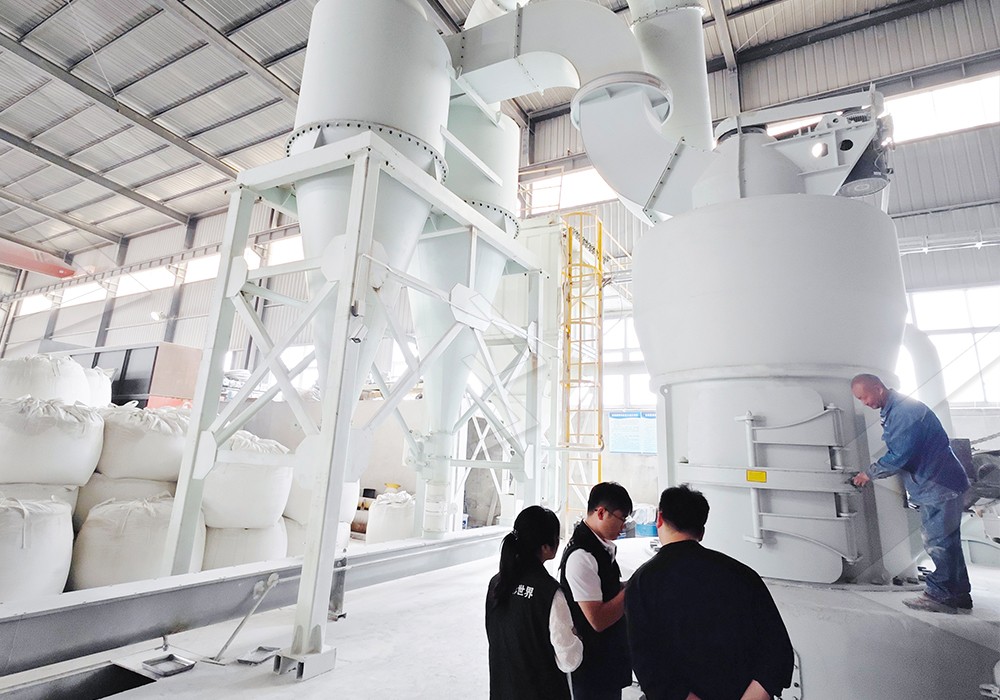
2. Grinding Efficiency and Energy Consumption
Grinding operations are significant energy consumers. Selecting a mill with high grinding efficiency is paramount for minimizing operating expenses. Modern mills utilize advanced grinding principles—such as roller/race geometry, centrifugal force, and material bed compression—to achieve higher yields with lower specific energy consumption (kWh/t). This directly translates to reduced electricity costs and a smaller carbon footprint for the entire FGD process.
3. System Reliability and Maintenance Needs
Unplanned downtime in a critical process like FGD can lead to non-compliance with emissions regulations. The grinding mill must be robust, reliable, and designed for continuous operation. Key considerations include the lubrication system (e.g., centralized automatic lubrication vs. manual greasing), the wear resistance of grinding elements (rollers, rings, liners), and the ease of accessing and replacing these wear parts. A design that allows for external maintenance without entering the grinding chamber is a significant advantage.
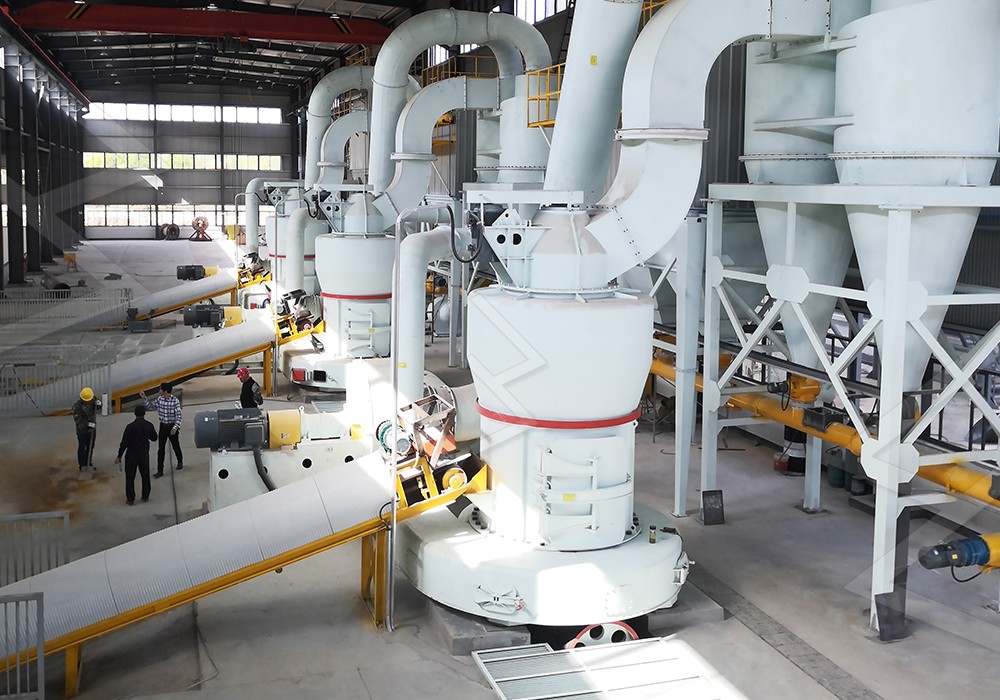
4. Environmental and Noise Control
The milling process must not create a secondary environmental issue. An effective pulse jet baghouse dust collector is essential to capture airborne particles, ensuring no dust escapes during operation. Furthermore, the mill should be equipped with noise suppression technology, such as acoustic enclosures or silencers, to protect workers and meet local noise ordinances. A fully enclosed, negative-pressure system is the industry standard for eco-friendly operation.
5. Drying Capacity and Material Moisture
While limestone is often relatively dry, some quarries may supply material with higher moisture content. If the feedstock has significant moisture, the mill must integrate a drying function. Hot air from the plant or a dedicated hot gas generator can be introduced into the mill to simultaneously dry and grind the limestone, ensuring the final product is dry and free-flowing, which is vital for pneumatic conveying and reactivity.
Recommended Solution: MW Ultrafine Grinding Mill
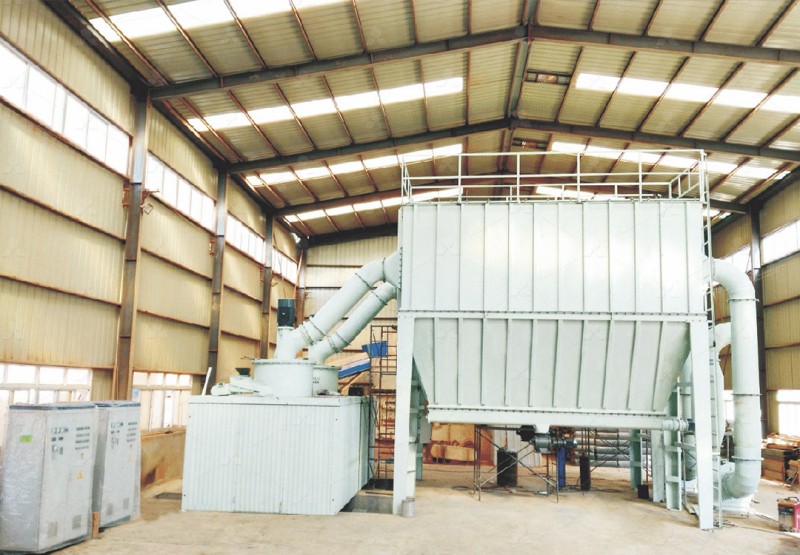
For applications demanding ultra-fine limestone powder with superior reactivity, our MW Ultrafine Grinding Mill presents an ideal solution. Engineered for high efficiency and environmental responsibility, it excels in producing precisely controlled powders between 325 and 2500 meshes. Its innovative design features a German-technology cage-type powder selector for exceptional classification accuracy and a grinding chamber devoid of rolling bearings and screws, eliminating common failure points and enabling worry-free, continuous 24/7 operation.
Equipped with an efficient pulse dust collector and muffler, the MW series ensures a clean and quiet working environment, fully adhering to national environmental protection standards. With a capacity range of 0.5-25 TPH and the ability to handle feed sizes up to 20mm, it offers a perfect balance of high output and low energy consumption for modern desulfurization needs.
Frequently Asked Questions (FAQ)
Q1: What is the typical fineness required for limestone in wet FGD systems?
A: Most wet FGD systems require ground limestone where 90-95% of the particles pass through a 325-mesh (44 micron) screen. This fine size maximizes the surface area for the acid-base reaction with SO₂.
Q2: Why is energy consumption such a critical factor in mill selection?
A: The grinding mill can be one of the largest energy consumers in the FGD preparation circuit. A more efficient mill directly reduces electricity costs, which constitute a major portion of the operating expenses over the equipment’s lifetime.
Q3: How does the MW Mill handle maintenance to minimize downtime?
A: The MW Mill is designed with maintenance in mind. Its external lubricating device allows for lubrication without shutdown. Furthermore, the absence of vulnerable components like rolling bearings and screws inside the grinding chamber drastically reduces the risk of internal mechanical failure and the need for disruptive maintenance.
Q4: Can the recommended mill handle variations in limestone hardness?
A: Yes, the MW Ultrafine Grinding Mill is built to process various non-metallic minerals with different hardness levels. The grinding pressure and classifier speed can be adjusted to maintain consistent product fineness despite variations in feed material properties.