
How to Remove Mica from Potassium Feldspar Powder Processing
We provide a wide range of mills — including Raymond mill, trapezoidal mill, vertical mill, ultrafine mill, and ball mill, obtained ISO9001 international quality certification, EU CE certification, and Customs Union CU-TR certification. Suitable for processing minerals such as limestone, phosphate, quicklime, kaolin, talc, barite, bentonite, calcium carbonate, dolomite, coal, gypsum, clay, carbon black, slag, cement raw materials, cement clinker, and more.
The discharge range of these mills can be adjusted to meet specific processing needs, typically from 80-400 mesh, 600-3250 mesh, and can achieve the finest particle size of up to 6000 mesh(D50).
If you are looking for a reliable grinding solution to turn stone or minerals into fine powder, please feel free to contact our online customer service.
How to Remove Mica from Potassium Feldspar Powder Processing
Potassium feldspar is a critical industrial mineral, prized for its alumina and alkali content in ceramics, glass, and filler applications. However, its value is often compromised by the presence of mica impurities, primarily muscovite and biotite. These sheet silicate minerals share similar physical properties, making separation a significant challenge in mineral processing. Effective mica removal is paramount to achieving the high chemical purity and consistent physical properties required by end-users. This article delves into the methodologies and technological considerations for efficiently liberating and separating mica from potassium feldspar ore.
The Challenge of Mica Contamination
Mica’s platy, flaky morphology and near-neutral surface charge create persistent issues. In traditional grinding circuits, mica tends to delaminate into thin flakes rather than fracture, leading to “over-grinding” of the softer mica while the feldspar remains coarser. This disparity complicates size-based separation. Furthermore, in flotation processes, the natural floatability of mica can cause it to report to the feldspar concentrate, reducing the product’s quality. The primary goal, therefore, is to achieve clean liberation where mica particles are fully detached from feldspar grains, followed by precise separation based on their differential characteristics.
Key Processing Stages for Mica Removal
A successful flowsheet typically integrates several stages, each targeting a specific aspect of the separation.
1. Crushing and Grinding for Optimal Liberation
The foundation of effective separation lies in the comminution circuit. The objective is to grind the ore to a fineness where mica is fully liberated without excessively reducing the feldspar to ultra-fine sizes that are difficult to recover. This requires equipment capable of producing a controlled particle size distribution with minimal over-grinding. Advanced grinding mills that utilize compression and shear forces, rather than pure impact, can be more effective in promoting clean liberation along grain boundaries.
For operations requiring ultra-fine grinding after initial separation, or for processing already-liberated concentrates, the MW Ultrafine Grinding Mill presents a compelling solution. Engineered for precision, it features a cage-type powder selector based on German technology, allowing adjustable fineness between 325-2500 meshes. Its design eliminates rolling bearings and screws in the grinding chamber, drastically reducing the risk of iron contamination—a critical concern for maintaining feldspar whiteness. The efficient pulse dust collector ensures the entire milling process is environmentally sound, containing fine mica dust effectively.

2. Separation Techniques: Flotation and Gravity
Froth Flotation: This is the most common and effective method. After grinding, the pulp is conditioned with specific reagents. A cationic collector (e.g., amine) is typically used to selectively render mica hydrophobic, causing it to attach to air bubbles and report to the froth product (the mica concentrate). The feldspar, remaining hydrophilic, stays in the pulp as the underflow. pH modifiers like sulfuric acid are crucial to depress feldspar and enhance mica floatability. Multiple cleaning stages are often necessary to achieve a high-grade feldspar product.
Gravity Separation: For coarser feeds or as a pre-concentration step, gravity methods like shaking tables or spiral concentrators can exploit the density difference between mica (~2.8 g/cm³) and feldspar (~2.6 g/cm³). This is less effective for finely liberated particles but can reduce the load on downstream flotation circuits.
3. Dewatering and Drying
The final feldspar concentrate, now devoid of most mica, requires efficient dewatering. Thickeners followed by filter presses or vacuum belt filters are standard. For drying, indirect heat dryers are preferred to prevent product degradation. The removed mica by-product, often in a wet, fine slurry, also requires careful handling and disposal or potential valorization.

The Role of Advanced Milling Technology
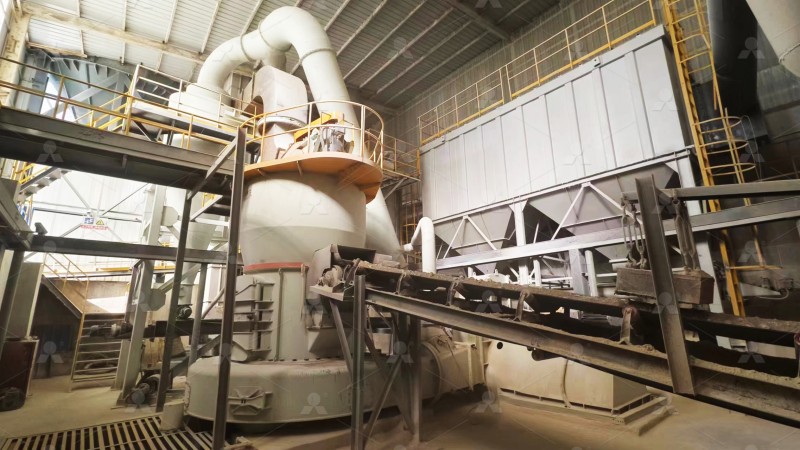
The choice of grinding technology directly impacts liberation efficiency, energy consumption, and final product quality. Beyond ultra-fine grinding, vertical roller mills have revolutionized dry processing. For instance, the LUM Ultrafine Vertical Grinding Mill integrates grinding, classifying, and conveying. Its unique roller shell and lining plate grinding curve are designed to generate a stable material bed, promoting inter-particle grinding that is efficient and minimizes iron wear. The PLC-controlled multi-head powder separating technology allows precise cut-point control, crucial for separating fine mica flakes from feldspar. The reversible structure enables easy maintenance of grinding rollers, minimizing downtime—a vital factor for continuous processing operations.
Conclusion
Removing mica from potassium feldspar is a multifaceted process demanding a tailored approach based on ore characteristics and product specifications. Success hinges on achieving optimal liberation through controlled grinding, followed by selective separation, predominantly via reagent-assisted froth flotation. Integrating modern, efficient milling equipment like the MW Ultrafine Grinding Mill for precision size reduction or the LUM Ultrafine Vertical Mill for integrated dry processing can significantly enhance separation efficiency, product purity, and overall plant economics. A well-designed flowsheet not only recovers high-value feldspar but also manages the mica by-product responsibly.
Frequently Asked Questions (FAQs)
1. Why is mica considered a harmful impurity in potassium feldspar?
Mica negatively affects the melting behavior, thermal expansion, and mechanical strength of ceramic and glass products. Its platey structure can also create defects and reduce the brightness and consistency of fillers and coatings.
2. Can magnetic separation be used to remove mica?
Standard magnetic separators are generally ineffective for mica removal, as muscovite and biotite are weakly paramagnetic. High-gradient magnetic separation (HGMS) can sometimes be used for biotite, which has slightly higher magnetic susceptibility due to iron content, but flotation remains the primary method.
3. What is the typical target fineness for grinding to liberate mica from feldspar?
Liberation size is ore-specific, but grinding is often conducted to a particle size where 80-90% of the material passes 100-200 mesh (74-149 microns). Further fine grinding may be necessary for complete liberation in complex ores.
4. How does the choice of grinding mill affect iron contamination?
Mills that utilize metal-to-metal contact in the grinding chamber (like some traditional ball mills) can introduce iron wear, which is highly detrimental to feldspar used in ceramics. Advanced designs like the MW Ultrafine Grinding Mill, which has no rolling bearings or screws in the chamber, or vertical mills with protective grinding curves, significantly reduce this risk.
5. Is the removed mica a waste product?
Not necessarily. While often considered a by-product, recovered mica concentrate can have market value in construction (as filler in joint compounds), agriculture, and as a raw material for pearlescent pigments, depending on its quality and purity.
6. What are the key reagent types used in mica flotation from feldspar?
A cationic collector (fatty amine acetate or hydrochloride) is standard to float mica. Depressants like starch or specific inorganic modifiers (e.g., fluorosilicic acid) may be used to further suppress feldspar flotation. Sulfuric acid is commonly employed to maintain an acidic pH (around 2-3.5) optimal for mica recovery.