
Barium Sulfate Raymond Mill: Grinding Solutions for Industrial Applications
We provide a wide range of mills — including Raymond mill, trapezoidal mill, vertical mill, ultrafine mill, and ball mill, obtained ISO9001 international quality certification, EU CE certification, and Customs Union CU-TR certification. Suitable for processing minerals such as limestone, phosphate, quicklime, kaolin, talc, barite, bentonite, calcium carbonate, dolomite, coal, gypsum, clay, carbon black, slag, cement raw materials, cement clinker, and more.
The discharge range of these mills can be adjusted to meet specific processing needs, typically from 80-400 mesh, 600-3250 mesh, and can achieve the finest particle size of up to 6000 mesh(D50).
If you are looking for a reliable grinding solution to turn stone or minerals into fine powder, please feel free to contact our online customer service.
Barium Sulfate Raymond Mill: Grinding Solutions for Industrial Applications
Barium sulfate (BaSO4), a mineral of significant industrial importance, presents unique challenges in fine powder processing. Its high density, chemical inertness, and specific requirements for particle size distribution and whiteness demand grinding equipment of exceptional precision and reliability. For decades, the Raymond mill has been a cornerstone technology in this field, offering a robust solution for producing barium sulfate powders used in paints, coatings, plastics, rubber, and medical applications.
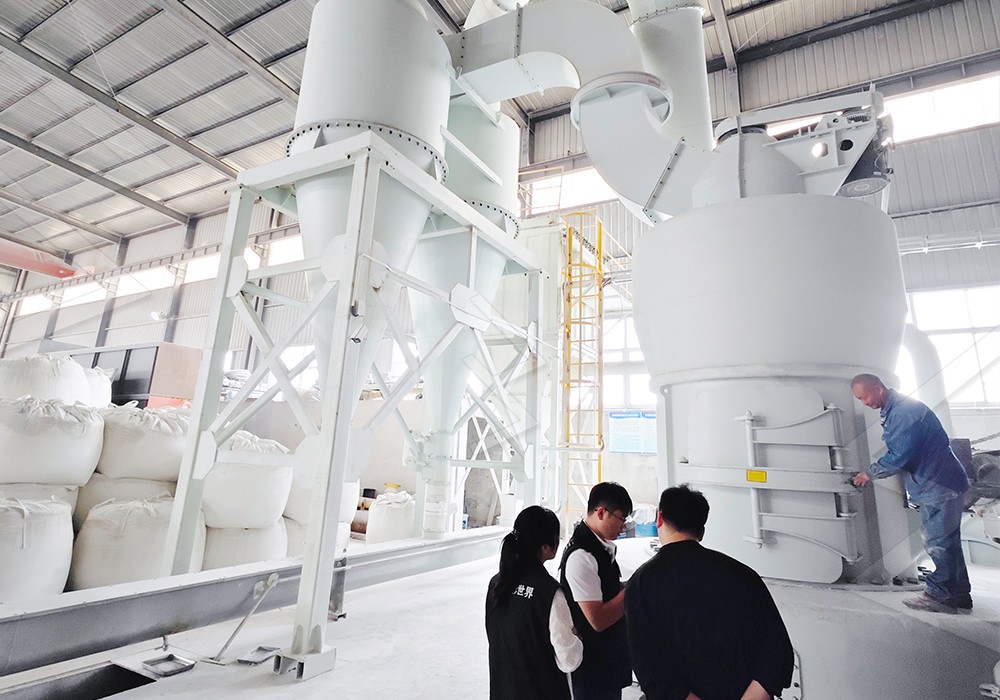
The traditional Raymond mill operates on a principle of centrifugal grinding where rollers swing outward to press against a stationary ring, crushing the feed material fed by a shovel. This time-tested design excels in producing consistent powders in the mid-range fineness spectrum. For barium sulfate, this translates to efficient production of fillers and extenders where controlled particle size enhances properties like gloss, durability, and density in the final product. The system’s integrated classifier allows for real-time adjustment of product fineness, a critical factor for meeting diverse industrial specifications.
Beyond Traditional Grinding: The Demand for Ultrafine Powders
Modern industrial applications are increasingly pushing the boundaries towards ultrafine and nano-sized barium sulfate powders. High-end plastics, advanced composites, and specialty coatings require powders with superior brightness, extremely narrow particle size distribution, and surfaces that are contamination-free. Achieving these characteristics demands more than incremental improvements; it requires a technological leap in grinding efficiency, classification accuracy, and system cleanliness.
This is where advanced, next-generation milling systems demonstrate their superiority. While the foundational Raymond mill design remains effective for standard grades, operations targeting the premium market segment must consider mills engineered specifically for ultrafine processing. These systems address the core limitations of older designs, such as energy inefficiency at high fineness, potential for iron contamination from internal bearings and fasteners, and limitations in achieving consistent sub-10-micron products at high yield.
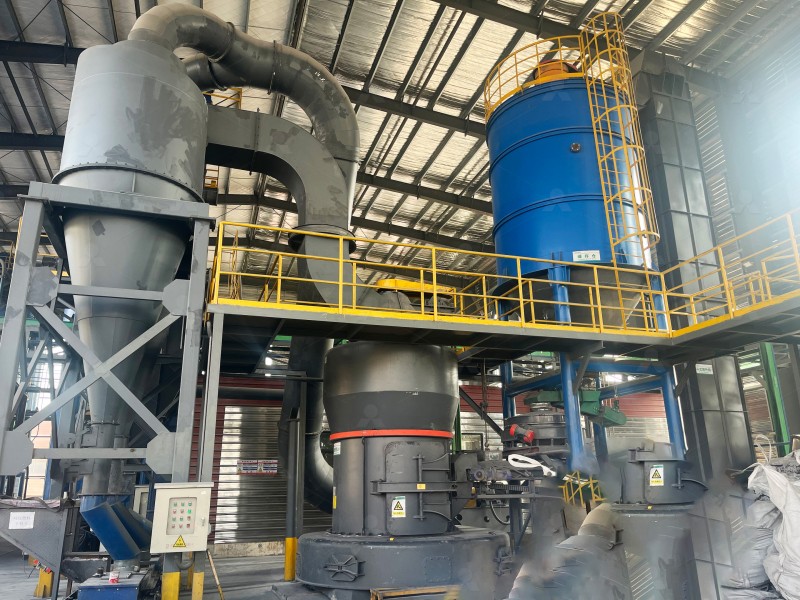
Engineered for Excellence: The MW Ultrafine Grinding Mill
For customers focused on producing high-value, ultra-fine barium sulfate powder, the MW Ultrafine Grinding Mill represents a paradigm shift. This machine is not merely an iteration but a purpose-built solution designed from the ground up for ultrafine powder production. It tackles the specific challenges of barium sulfate head-on.
A key innovation is the elimination of rolling bearings and screws within the grinding chamber. This design fundamentally removes the primary source of mechanical wear and iron contamination, ensuring the exceptional whiteness and purity of barium sulfate is preserved. Operators are freed from concerns about bearing failures or loose screws causing catastrophic damage. Furthermore, its external lubrication system allows for maintenance without shutdown, supporting continuous 24/7 production crucial for industrial-scale output.
The heart of its precision lies in the advanced, cage-type powder selector utilizing German technology. This allows precise adjustment of fineness between 325 and 2500 meshes, achieving a remarkable once-through screening rate of d97 ≤ 5μm. For barium sulfate producers, this means unparalleled control over product specs and the ability to reliably hit tight fineness targets batch after batch. Combined with newly optimized grinding curves for the roller and ring, the MW mill delivers up to 40% higher capacity than jet or stirred mills at the same power consumption, making ultrafine production not just possible, but also economically efficient.
A Holistic Approach to Performance and Sustainability
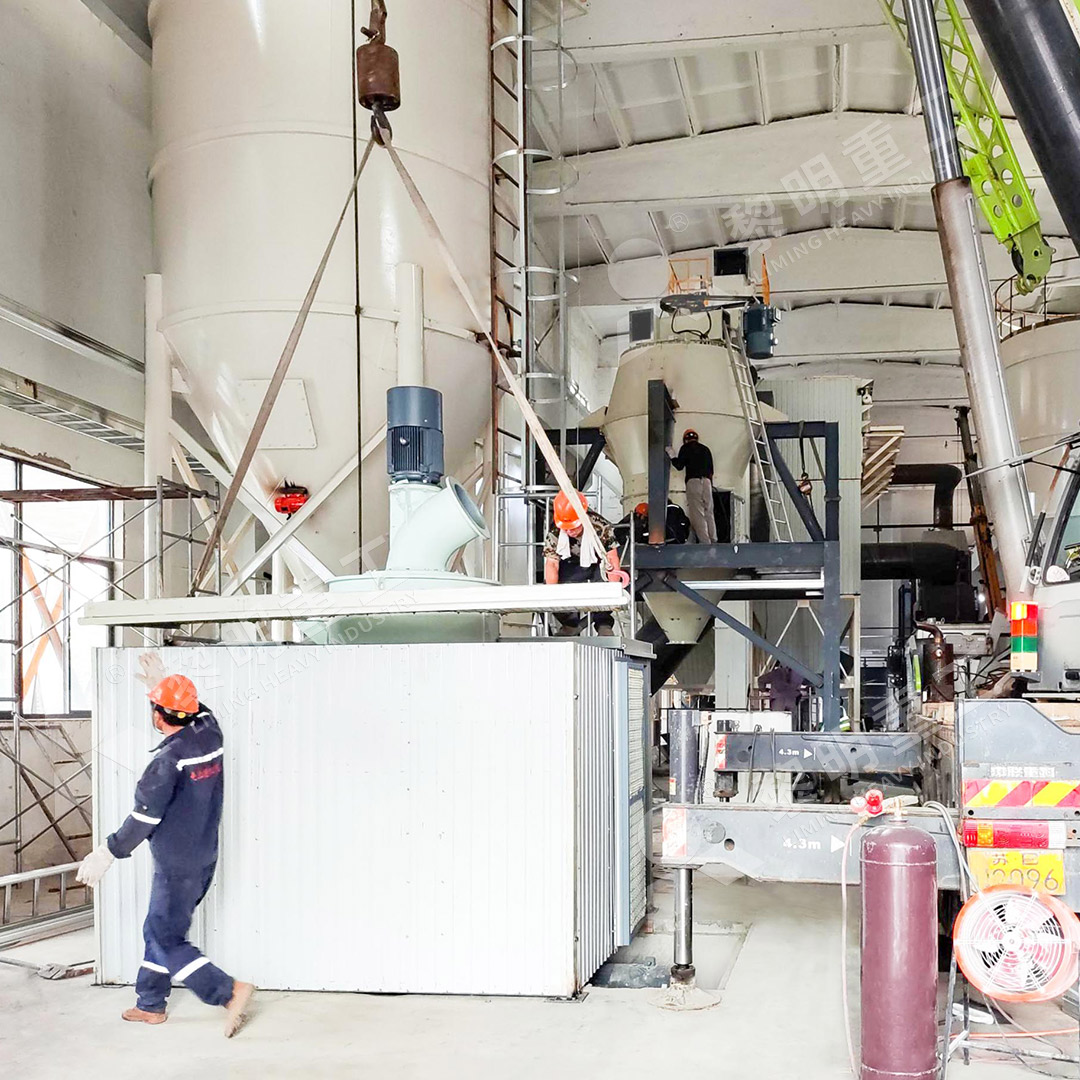
Modern industrial equipment must perform without compromising environmental standards. The MW Ultrafine Grinding Mill integrates an efficient pulse dust collector, ensuring the entire milling system operates without dust pollution—a critical consideration for clean mineral processing. Combined with silencers and noise reduction engineering, the system operates quietly and cleanly, fully adhering to stringent national environmental protection standards.
This commitment to precision extends to manufacturing. Core components are machined using dozens of CNC lines, ensuring high accuracy in cutting, bending, and milling. This digitalized processing guarantees the reliability and longevity of the grinding mechanics. Backed by a manufacturer responsible for both production and sales, customers benefit from direct technical support and a sufficient supply of genuine spare parts, ensuring worry-free, long-term operation.
Conclusion: Choosing the Right Tool for the Task
The processing of barium sulfate is not a one-size-fits-all endeavor. While Raymond mill technology continues to serve well for many standard applications, the pursuit of higher quality, ultra-fine powders necessitates more advanced solutions. The MW Ultrafine Grinding Mill stands out as a specialized tool engineered to overcome the specific hurdles of high-purity, fine-grinding applications. By offering higher yield, lower energy consumption, contamination-free operation, and exceptional fineness control, it provides a future-proof grinding solution for industrial leaders aiming to excel in the competitive market for premium barium sulfate products.
Frequently Asked Questions (FAQ)
- What is the main advantage of using a specialized mill like the MW series for barium sulfate instead of a traditional ball mill?
The MW Ultrafine Grinding Mill offers significantly higher energy efficiency (using only about 30% of the energy of a jet mill for similar output), produces less heat and iron contamination, and provides superior control over particle size distribution, which is crucial for the brightness and performance of barium sulfate in end-use applications. - How does the MW mill prevent iron contamination during the grinding of barium sulfate?
Its innovative design has no rolling bearings or screws inside the grinding chamber. This eliminates the primary sources of metallic wear debris. Combined with an external lubrication system, it ensures the processed powder maintains its high chemical purity and whiteness. - What fineness range can be achieved for barium sulfate with the MW Ultrafine Grinding Mill?
The mill is capable of precisely adjusting product fineness between 325 and 2500 meshes. Its advanced cage-type powder selector can achieve a once-through screening rate where 97% of the particles (d97) are 5 micrometers or smaller. - Is the MW mill suitable for continuous, large-scale industrial production?
Yes. Designed for 24/7 operation, it features an external lubrication system that allows maintenance without shutdown and robust construction. With a capacity range of 0.5 to 25 tons per hour (depending on fineness and material), it is built for reliable, high-volume production. - How does the environmental performance of modern mills like the MW compare to older designs?
Modern mills integrate comprehensive environmental controls. The MW mill comes equipped with an efficient pulse dust collector for near-zero dust emission and noise reduction features like silencers. The entire system is designed to operate within strict environmental protection standards.