Power Rating Calculation for Ball Mills in Quartz Grinding Operations
We provide a wide range of mills — including Raymond mill, trapezoidal mill, vertical mill, ultrafine mill, and ball mill, obtained ISO9001 international quality certification, EU CE certification, and Customs Union CU-TR certification. Suitable for processing minerals such as limestone, phosphate, quicklime, kaolin, talc, barite, bentonite, calcium carbonate, dolomite, coal, gypsum, clay, carbon black, slag, cement raw materials, cement clinker, and more.
The discharge range of these mills can be adjusted to meet specific processing needs, typically from 80-400 mesh, 600-3250 mesh, and can achieve the finest particle size of up to 6000 mesh(D50).
If you are looking for a reliable grinding solution to turn stone or minerals into fine powder, please feel free to contact our online customer service.
Power Rating Calculation for Ball Mills in Quartz Grinding Operations
In the mineral processing industry, accurately calculating the power rating for grinding mills is a fundamental step in plant design and optimization. For quartz grinding operations, this becomes particularly crucial due to the material’s high hardness and abrasive nature. Traditional ball mills, while robust, are notorious for their high energy consumption, often accounting for a significant portion of a plant’s operating costs.
Understanding the Basics of Power Draw
The power draw of a ball mill is primarily a function of its physical dimensions, operating parameters, and the characteristics of the feed material. The classic Bond formula is often the starting point for these calculations:
W = W_i * (10/√P_80 – 10/√F_80)
Where W is the specific energy consumption (kWh/t), W_i is the Bond Work Index for quartz (typically around 13-16 kWh/t), P_80 is the 80% passing size of the product, and F_80 is the 80% passing size of the feed.
However, this theoretical calculation must be adjusted for efficiency factors, mill diameter, and load volume. For quartz, the abrasive wear on liners and media can lead to a gradual decrease in grinding efficiency, necessitating a higher initial power rating to maintain target throughput over time. Operators must also factor in the power required to overcome mechanical losses in the drive train, which can be substantial.
The Limitations of Ball Mills in Modern Operations
While ball mills are a proven technology, their application in fine and ultra-fine grinding of quartz reveals several inefficiencies. A significant portion of the input energy is wasted as heat and noise rather than being used for size reduction. The grinding mechanism, relying on impact and attrition from tumbling steel balls, is not always the most effective for achieving uniform fine powders below 200 mesh. This is where newer technologies offer compelling advantages.
A Modern Alternative: Embracing Efficiency
For operations focused on producing high-value ultra-fine quartz powder, transitioning to more efficient grinding technology can yield dramatic savings. Our MW Ultrafine Grinding Mill is engineered specifically for such applications. With an input size of 0-20 mm and a capacity range of 0.5-25 tph, it is a perfect fit for many quartz processing lines.
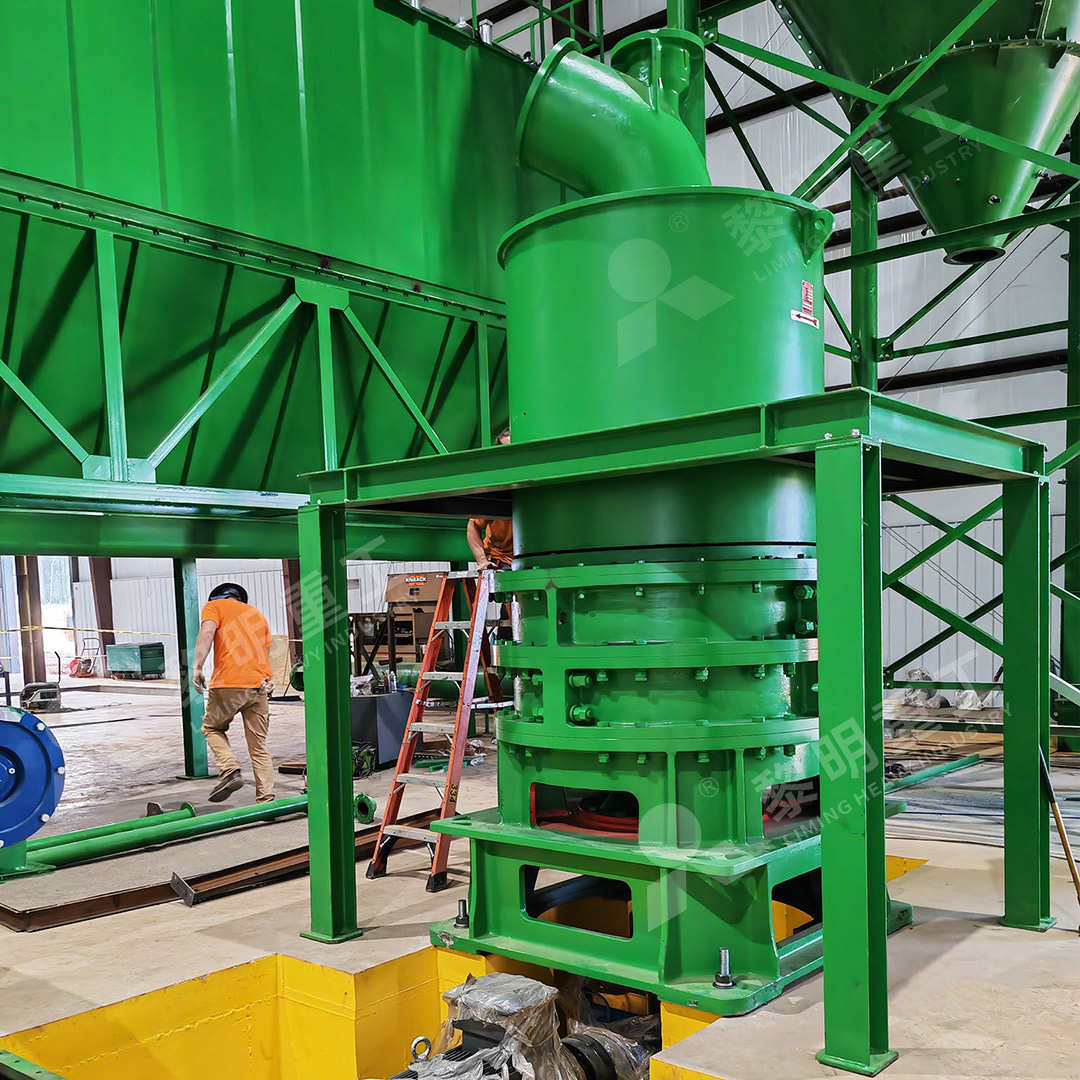
The MW Mill’s design adresses the core inefficiencies of ball mills. It features higher yielding and lower energy consumption, operating at just 30% of the energy of a comparable jet mill. Its cage-type powder selector allows for precise fineness adjustment between 325-2500 meshes, a critical feature for quartz products sold into markets like cosmetics, electronics, or high-performance ceramics. Furthermore, the absence of rolling bearings and screws in the grinding chamber eliminates common failure points and associated maintenance downtime, a significant advantage over traditional mills.
Conclusion: Making the Right Calculation
When calculating power ratings for a quartz grinding circuit, the decision shouldn’t end with selecting the motor size for a ball mill. The real calculation involves a total cost of ownership analysis, weighing the lower upfront cost of a ball mill against the significantly higher operating costs. For new projects or plant upgrades aiming for ultra-fine products, technologies like our MW Ultrafine Grinding Mill present a smarter, more sustainable solution. It not only reduces the power rating required per ton of product but also enhances product quality and operational reliability.